

Executive Summary: The Value of Precision
This report details the engineering optimization of an industrial thermal process. In modern manufacturing, temperature control is not merely a technical requirement—it is a direct lever for profitability.
The Operational Challenge: Legacy control systems often suffer from sub-optimal tuning, leading to “temperature hunting” and aggressive actuator movements. These inefficiencies result in:
- Energy Waste: Excessive fuel or power consumption during stabilization.
- Asset Degradation: High-frequency oscillations that accelerate mechanical wear on valves and heating elements.
- Quality Variance: Fluctuations that risk product spec compliance.
Our approach delivers a tiered optimization strategy: transitioning from Enhanced Industrial PID to high-performance Model Predictive Control (MPC).
Digital Twin & System Identification
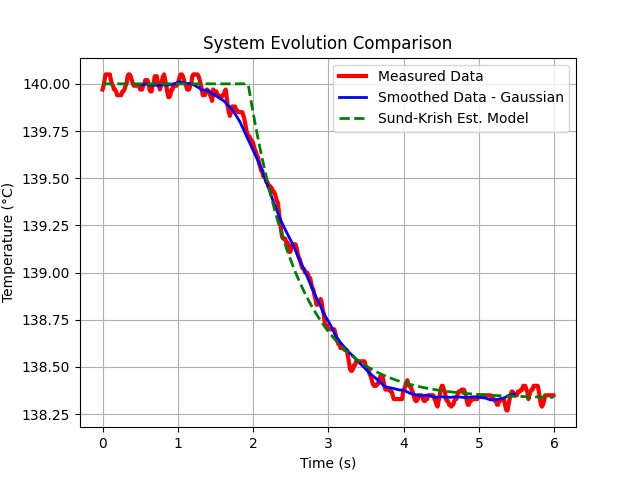
High-performance control starts with mathematical precision. Sundaresan–Krishnaswamy method has been winner method to estimate a high-fidelity model in this project. Capturing critical transport delays (1.59 min) and process inertia. This “Digital Twin” allows for simulation and informed tuning before deployment.
Tier 1: Enhanced Industrial PID (Baseline Optimization)
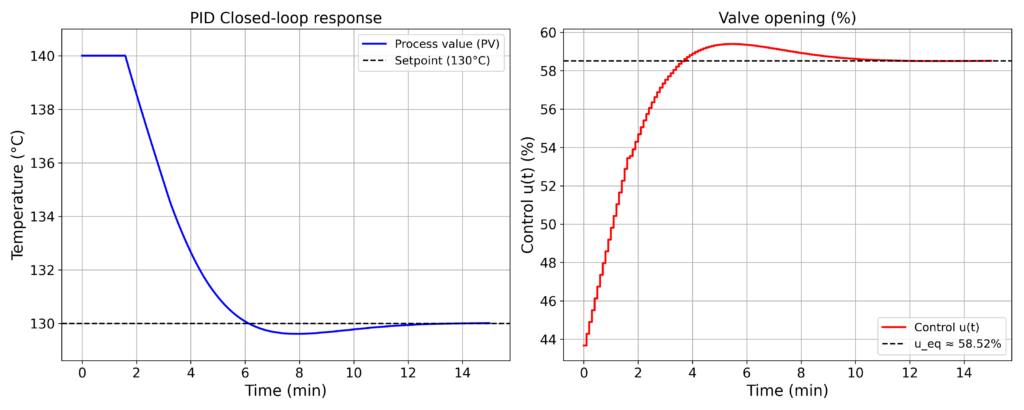
The first tier of optimization focuses on maximizing existing hardware. By utilizing Internal Model Control (IMC) tuning, we eliminate the “trial and error” approach.
Key Reliability Features:
- Signal Conditioning: Implementation of a derivative filter to prevent actuator “chatter” caused by sensor noise.
- Anti-Windup Logic: Ensures rapid recovery from process saturations without dangerous temperature overshoots.
Tier 2: Discrete Linear Quadratic Regulator
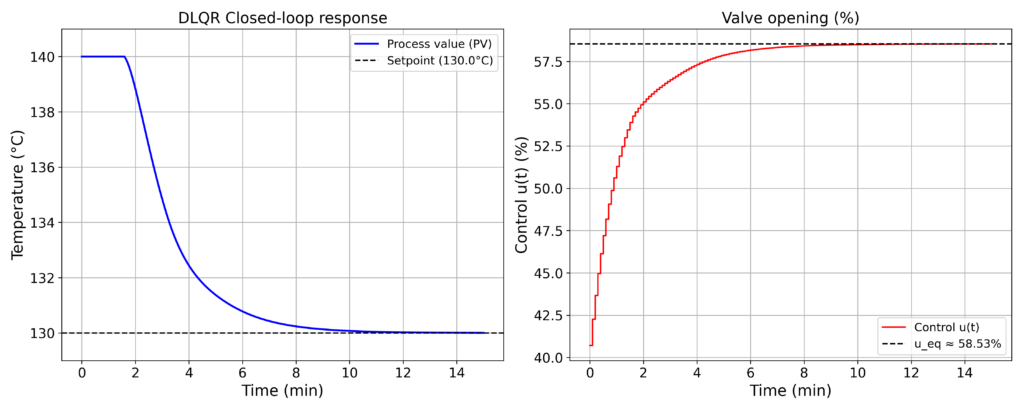
For processes requiring good gain and phase margin stability, we implement Discrete Linear Quadratic Regulator (DLQR). This strategy takes into account the weight that the controller will assign to the states, the control effort, and the accumulated error.
Strategic Advantages:
- Dead-Time treatment: The DLQR considers the transport delay as a buffer and treats it easily in the discrete domain, enabling its treatment through the weights in its design.
- Smooth response: By carefully selecting the weights, this control allows for a smooth response for both the states and the controller.
Tier 3: Model Predictive Control (The Gold Standard)
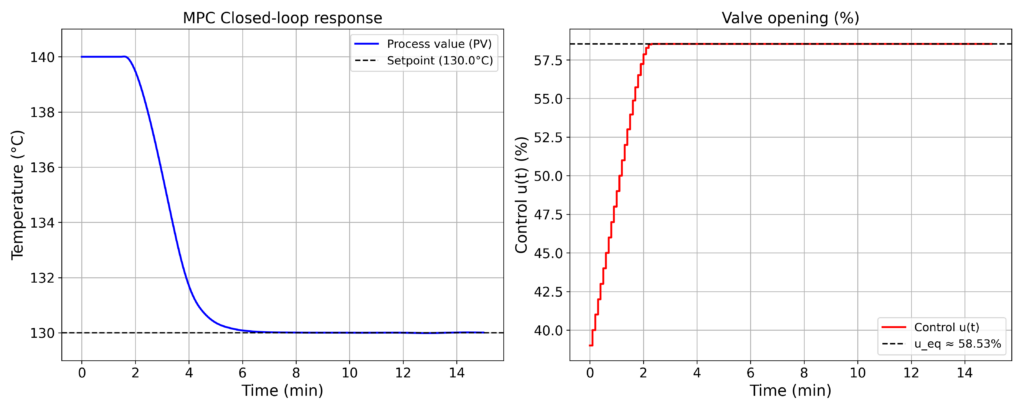
For processes requiring maximum stability and asset protection, we implement Model Predictive Control (MPC). This strategy anticipates process shifts rather than simply reacting to them.
Strategic Advantages:
- Proactive Dead-Time Compensation: The MPC “sees” the transport delay and adjusts the control action ahead of time.
- Constraint Awareness: Operates within the safe limits of your equipment, preventing saturation and electrical stress.
mechanical fatigue.
Comparative Analysis & ROI Projection
The following metrics quantify the operational impact of a standard PID, a DLQR and a Predictive strategy.
| Metric | Optimized PID | DLQR | MPC | Impact |
| Precision (ISE) | 263.80 | 261.40 | 259.18 | Lower energy & waste |
| Actuator Wear (TV) | 21.29 | 19.53 | 19.53 | +12% Asset Life Extension |
| Control Smoothness (ECQ) | 29.31 | 16.89 | 21.94 | Reduced electrical stress |
Conclusion & Recommendations
- Standard Operations: The Optimized PID is a cost-effective solution for non-critical loops.
- High-Value Assets: The MPC is recommended for continuous production lines where Asset Longevity and Energy Savings provide the highest long-term Return on Investment (ROI).